


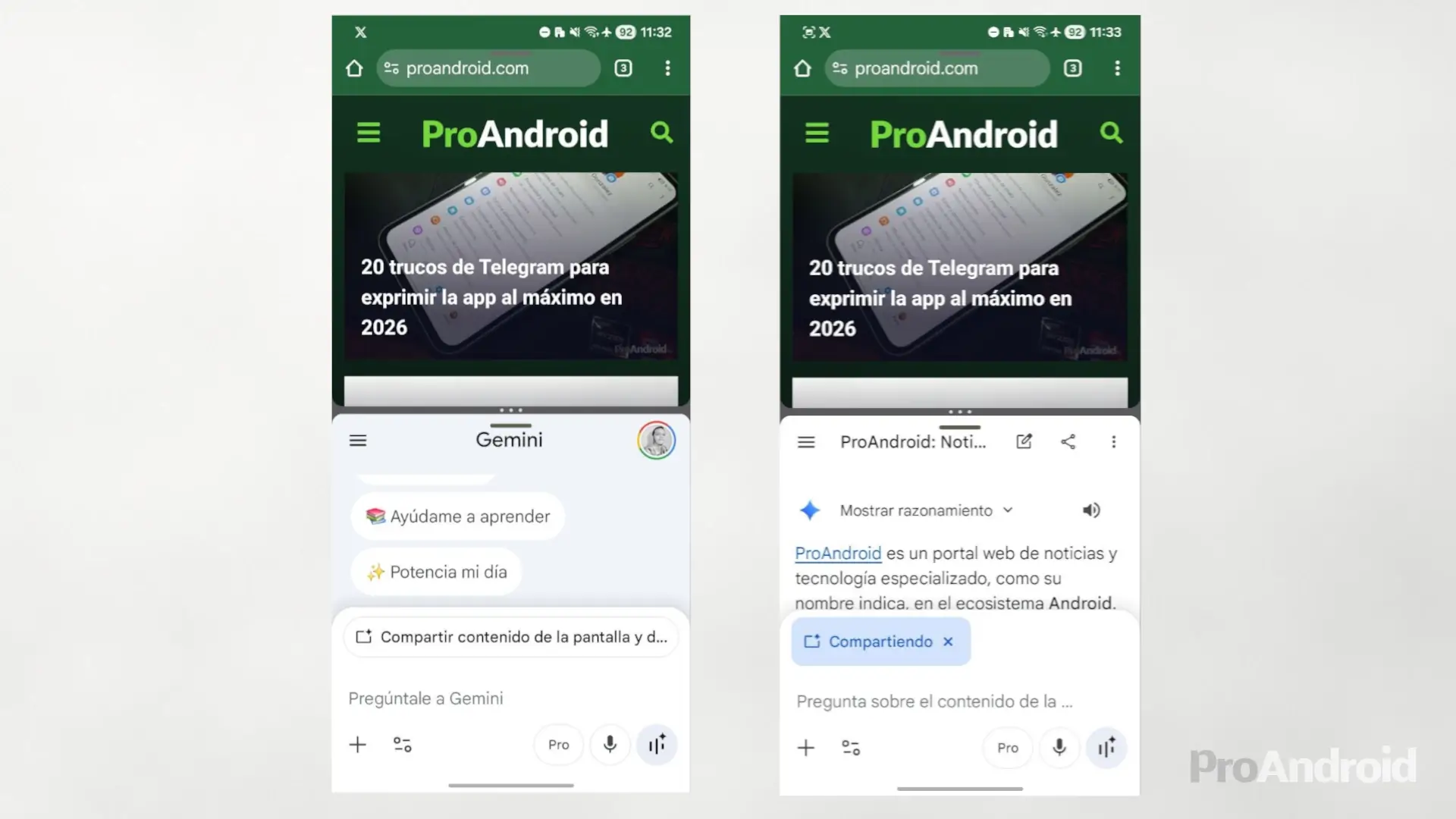

If you're one of those who tried to use Google's artificial intelligence while doing something else, you probably hated that annoying overlay. Until recently, invoking the wizard meant covering up a large part of your main application, breaking the workflow and forcing you into a constant dance of opening and closing windows. Luckily, that clumsy experience is history.
Google has begun to deploy a highly requested function on conventional mobile phones: the native split screen for Gemini. We are no longer talking about a floating panel that gets in the way, but rather a real integration that allows you to anchor the AI in one half of the panel and keep your browser, map or video in the other, operating both at the same time without interruptions.
A brain that sees what you see
What is truly useful is not only that the windows share space, but that they understand each other. The update reinforces the key button: share screen and content of the app. When you press it, Gemini analyzes in real time what is happening in the other half, whether it is a YouTube video or an email. This eliminates the friction of taking manual captures, offering instant contextual responses and bringing the mobile productivity to that of a desk.
However, this deep integration has a double reading. While it improves our lives, it also borders on limits monitored by the European Union with its Digital Markets Law, since Google gives itself system advantages that competitors such as ChatGPT They can hardly replicate due to Android's own restrictions.
Do you think this convenience justifies Google shutting down the ecosystem, or should we sacrifice features in exchange for fairer competition?