Google continues to refine small details of Android that can make a difference in everyday life, and the next one on the list has to do with something as basic as share our contact details quickly and securely with another person.
A teardown of the application – the classic APK analysis (Android Package, the application installation file on Android) – has brought to light Contact Exchange, also called internally Gesture Exchangea hidden feature in Google Play Services that aims directly to compete with NameDropthe equivalent proposal that already exists in iOS (iPhone Operating System), Apple's mobile operating system.
This is how Contact Exchange would work on your Android mobile
According to the text chains and screens discovered, Contact Exchange would allow two mobile phones to be brought together and, through NFC (Near Field Communication, short-range communication), initiate the exchange of contact cards. The idea is that you don't have to look for menus, codes QR (Quick Response, quick response codes) nor write anything: a physical gesture is enough for both phones to recognize each other and the process to start.
On the first screen, very similar to NameDrop on the iPhone, the user can choose what they want to share: profile photo, phone number and email. A “Receive only” button also appears, designed for those who prefer to save the other person's contact without immediately handing over their own personal data.
After selection, a second screen shows the received contact cardwith the name, profile image and data that the other person has decided to share. From there you can save the contact to your phonebook with a tap or even directly start a video call or text message, although in practice most will probably just use the quick save function.
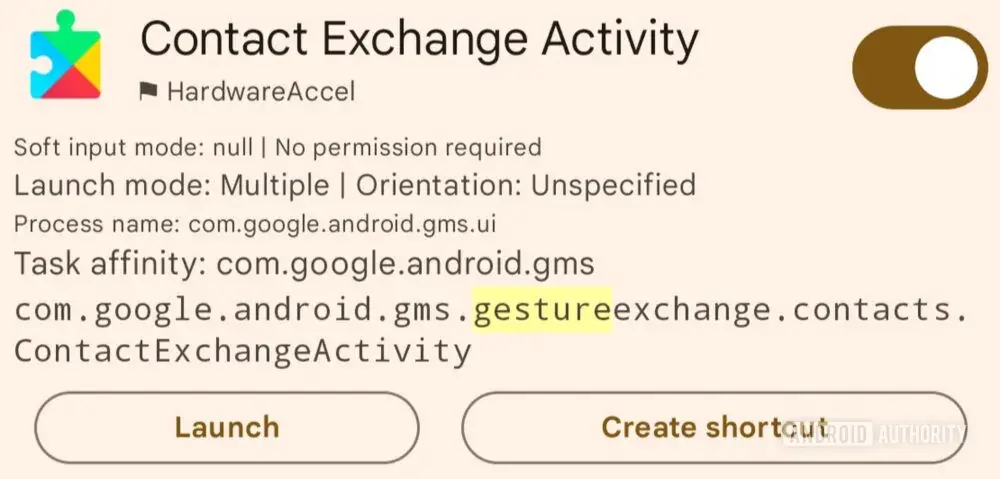
All this information has been extracted from text strings present in recent versions, specifically in beta versions 25.44.32 and 25.46.31, where the names are mentioned Gesture Exchange and ContactExchangeActivity along with references to NDEF (NFC Data Exchange Format, data exchange format for NFC)which reinforces the idea that the system is based on this short-range technology.
As always in this type of findings, we are talking about a APK teardownthat is, reviewing the code of an APK in search of functions in development that are not yet active for the user. This means that Contact Exchange could change its name, appearance, or even never reach the end user.
When could Google NameDrop reach our phones?
The good news is that, depending on Google Play Services and not a major system update, it would be logical for Contact Exchange to be activated through a future silent update or within a Android Feature Drop. This would allow many Android phones to receive it at the same time, without waiting for each manufacturer to prepare its own version of the system.
For now there are no official deadlines or public confirmation from Google, so it is worth taking everything with caution. Even so, the existence of almost finished screens and the clear inspiration in NameDrop suggest that in Mountain View They see this feature as a logical step to modernize something as simple as sharing a phone or email with the person in front of you.
If it is finally launched, Contact Exchange It could become one of those small functions that you rarely use but are grateful for when you need them, especially at events, fairs or work meetings. Would you like your Android phone to have something like this so you can forget about business cards and hastily dictated numbers?