Qualcomm has presented the Snapdragon 6s Gen 4a chipset 4 nanometers designed to democratize better features in the entry and middle range. The company promises a 36% jump in CPU and 59% on GPU compared to the previous generation, along with support for 144Hzcameras 200 megapixels and more modern connectivity. These figures, on paper, indicate that affordable cell phones could be much more capable in daily use and, especially, in games.
The key is in the change of architecture. Qualcomm maintains the cores Cortex‑A78 and Cortex‑A55but it goes to a 4+4 configuration (four high performance up to 2.4GHz and four efficiency up to 1.8GHz) manufactured in 4nm. This balance should translate into better multitaskshorter charging times and lower consumption compared to the 6nm from the previous Snapdragon 6s Gen 3.
What improvements does the Snapdragon 6s Gen 4 bring?
The platform arrives with a more ambitious gaming package in this price range: Variable Rate Shading to optimize rendering, Game Quick Touch to reduce touch latency and support FHD+ at 144Hz. In practice, competitive titles and demanding emulators should move more fluidly than in previous generations.
In photography, the Qualcomm Spectra ISP admits 200MP capture, 2K HDR video at 30 fps and slow motion at 240 fps in 720p. Furthermore, it adds hardware noise reduction (MFNR) to improve low light scenes. These are improvements that, if the manufacturer accompanies them with good sensors, will improve the general level of the economic range.
Connectivity and memory: finally up to date
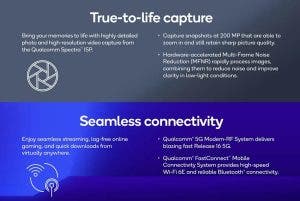
This 6s Gen 4 integrates a modem 5G Release 16 with download speed up to 2.9 Gbps, Wi-Fi 6E (up to 2.9 Gbps) and Bluetooth 5.4 with LE Audio. In storage and RAM, it supports UFS 3.1 and memories LPDDR5X (in addition to LPDDR4X) a key point for manufacturers to mount faster configurations without increasing costs.
When will we see it on mobile phones?
Qualcomm has not detailed manufacturers or dates, but, as usual, brands like Motorola, Xiaomi, Honor or Oppo They should release the chip in the coming months within their economic ranges and entry to the mid-range. If they deliver on performance and connectivity promises, we could be looking at one of the biggest improvements of series 6 in years.
A key boost for the economic range
Here it is evident that Qualcomm not only maintains its commitment to the high-end as in the case of the interesting Snapdragon 8 Elite Gen 5but also its commitment to economical terminals, and the best thing is that there is a real change compared to its predecessor. On paper, the Snapdragon 6s Gen 4 It attacks right where it hurts most on cheap phones: multi-core CPU, graphics, connectivity and camera. If the prices are right, it could be the leap that the entry-level range needed to offer a more rounded experience without raising the price. What do you think of this advance for affordable mobile phones? What do you prioritize: power, camera or battery? We read you in the comments.