OnePlus has presented Gaming Technologya platform with which it wants to take mobile gaming to another level and that will debut in the OnePlus 15 series. The proposal combines chip-level optimizations, dedicated hardware and proprietary software to address four key fronts: sustained performance, stability, touch latency and connectivity. The promise is to maintain a high frame rate with quality images, without stuttering or overheating.
The company talks about a deep reconstruction of the game execution stack on Android: It includes a new processor scheduler, a rendering engine that acts directly on the chipset and a custom screen with a refresh rate of up to 165Hz. All of this is supported by alliances with studios to enable native 165 frames per second (fps) in popular titles. On paper, the OnePlus 15 It is emerging as the general mobile phone with the ambition of a gaming terminal.
What is OP Gaming Core and why does it matter?
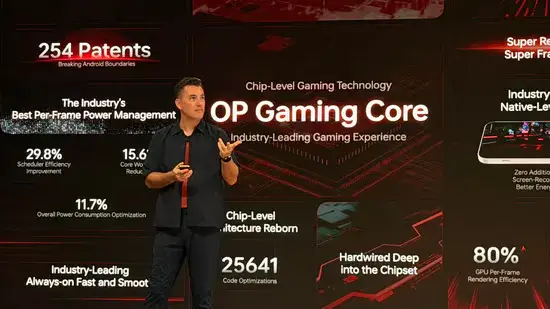
The core of the proposal is OP Gaming Core, a set of technologies integrated into the chip with which OnePlus promises to improve efficiency and control. Includes a OnePlus CPU Scheduler that prioritizes critical game tasks to reduce executed instructions and consumption, and a Next-Gen HyperRendering which reorganizes the GPU processing flow using Vulkan drivers optimized for increase efficiency per frame and minimize interpolation latency. Translated: fewer frame drops, better response and less energy expenditure for each frame generated.
OnePlus also states that this base allows maintain 120 fps stably in popular games, with fine control of consumption per frame and more predictable thermal management. This is relevant on Android, as many graphics acceleration features typically rely on separate chips or operating modes; Here, the firm integrates this logic directly into the SoC to reduce the usual bottlenecks of performance oscillations after several minutes of gaming.
Tri‑chip performance: 165Hz display and better touch
Above the software, OnePlus introduces an OP performance trichip with three pieces: the performance chip (based on the Snapdragon 8 Elite Gen 5) where OP Gaming Core is embedded; a touch response chip which offloads processing from the SoC and raises sampling to 330Hz sustained and 3200Hz touch sampling; and a Wi-Fi G2 chip with SmartLink algorithms to stabilize the connection in weak coverage environments. The idea is to reduce input latency, from touch interaction to network response.
The other key part is OP FPS Max, a 165Hz display ecosystem with support native 165fps and aligned touch and connectivity settings. OnePlus assures that there are already several compatible games and that it will expand the list with more partners. If what was promised is fulfilled, it would be an advantage over the current standard of 120Hz in the high-end “non-gaming” range, with a tangible improvement in shooters (shooting games)MOBAs and competitive titles.
A hit on the table to play on Android
Beyond marketing, this offensive places the OnePlus 15 as a serious candidate for those who prioritize gaming on Android: high refresh rates, more precise touch and promises of thermal stability. We will have to see how it translates into specific titles and if 165 fps support reaches Europe as quickly as in China and India. Are you attracted to this “gaming” bet in a generalist flagship or do you prefer a specialized ROG/RedMagic type mobile? We read you in the comments.