Google has lit another fuse in the quantum race. Your processor Willow (105 superconducting qubits) has run a new algorithm, Quantum Echoeswhich completes certain calculations 13,000 times faster than the best classical code on one of the most powerful supercomputers in the world. The work, verified and published in Naturepoints to a practical quantum advantage that can translate into real scientific advances, from computational chemistry to the development of new materials.
Beyond the headline, what is relevant is the verifiability: Google engineers assure that the result can repeated on another equivalent quantum processor and contrasted with measurable physical phenomena, something that has traditionally been the great Achilles heel of quantum demonstrations. The experiment models the dynamics of magnetic spins in NMR (nuclear magnetic resonance) and opens the door to describing molecules that today remain outside the classical scope in times of hours instead of years.
Quantum Echoes: why this algorithm matters
Most quantum milestones to date were difficult to test or relied on statistical tricks. Quantum Echoes proposes a different approach: it introduces periodic signals ('echoes') into the quantum system and analyzes its response without collapsing the quantum state of the information, reducing errors and enabling deterministic data. This approach transforms the simulation of certain quantum systems into an ideal task for a Quantum Processing Unit. (QPU)just where classical systems encounter serious difficulties.
In numbers, the team compares their algorithm on Willow with the best classic implementation available and with world-class supercomputingconcluding that 13,000× advantage. This does not imply that mobile phones will imminently incorporate quantum computing, nor that current artificial intelligence will become obsolete; It does imply that, for very specific tasks —molecular modeling, materials chemistry, physical optimization— a quantum chip with just over a hundred qubits can already provide us with useful and verifiable results.
What is Willow and what changes compared to previous advances
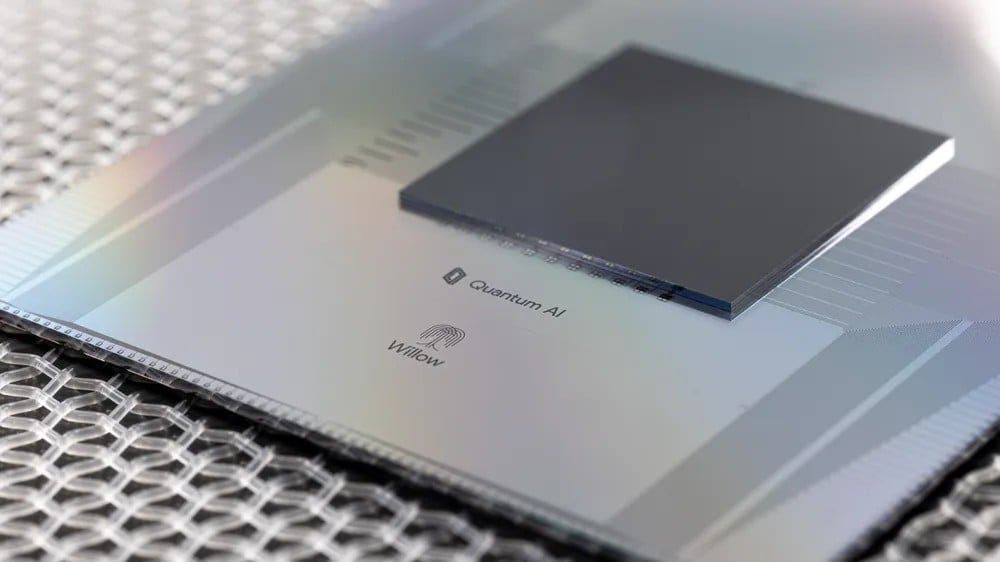
Willow is the successor to Google's quantum ecosystem presented at the end of 2024. It is a Superconducting QPU focused on consistency, control and error correctioncapable of running deep circuits with fidelities that enable more ambitious algorithms. Unlike the tests of “supremacy” of previous years – difficult to contrast and with diffuse applications – here the novelty is in solve a physics problem with scientific value and do it with audit criteria.
Willow technical sheet
- Architecture: superconducting quantum chip (Google Quantum AI)
- Qubits: 105 qubits addressable
- Key algorithm: Quantum Echoes (spin simulation/NMR)
- Advantage: 13,000× compared to the best classic alternative on a supercomputer
- Target applications: chemistry, materials, life sciences and scientific AI
What it means for Android, AI and the user
In the short term, it will not have an immediate impact on the performance of your mobile. But it does change the horizon for AI that designs drugs, catalysts or batteries: If we can simulate complex molecules reliably, models can be trained with better data and reach discoveries sooner. Google talks about practical applications in five years if you manage to scale the hardware and error control towards durable logical qubits. It is not empty marketing: it is a tangible intermediate step.
A window into quantum utility
Are we facing the definitive “quantum revolution”? Not yet. Scalability (go from hundreds to millions of logical qubits) and the fault tolerance They continue to be the great challenge. Still, see verifiable quantum advantage into a problem with physical significance is a milestone that pushes the entire industry. Are you convinced by this advance or does it seem like smoke to you? We read you in the comments.