



Installing applications outside of Google Play has always been one of the hallmarks of Android compared to iOS. That freedom, however, has its days numbered as we know it. Google has confirmed a new installation process which includes a mandatory 24-hour block and several additional steps for anyone who wants to install apps from unverified developers. It's not just another warning that you can ignore with a tap: it's a structural and deliberately uncomfortable change.
The official justification revolves around security. Attackers routinely use social engineering — panicked calls about legal problems or family emergencies — to guide victims while disabling protections and install malicious apps. The problem, the company itself recognizes, is not that the warnings fail, but that in pressure situations people ignore them. The new system is specifically designed to be slow: let friction do the work that warning cannot.
Six steps to install a single app
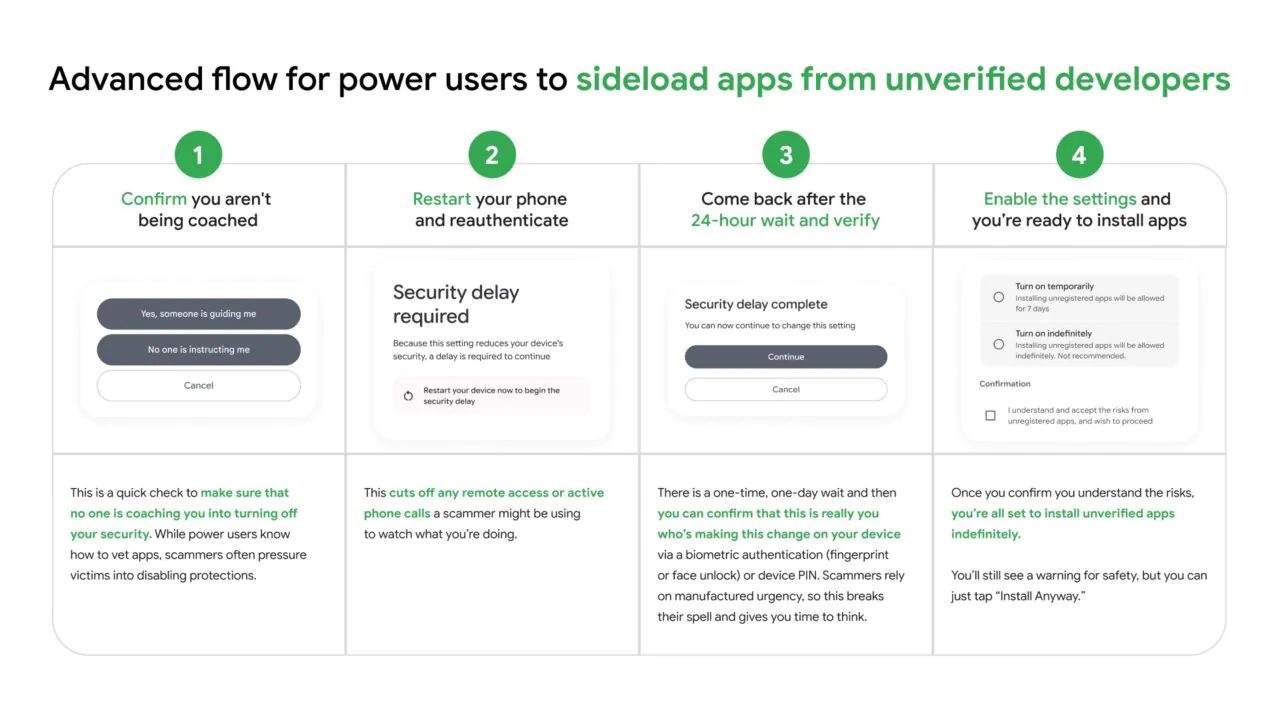
Google's new process is long by design. These are the steps you will have to follow:
- Activate developer options manually, without shortcuts.
- Confirm that no one is coercing you — Android will explicitly ask if someone is guiding you to disable protections, a direct response to scam tactics.
- Restart the phonewhich cuts off any active calls or remote access sessions a scammer might be using.
- Wait 24 hours — mandatory blocking designed to eliminate the urgency that scammers exploit.
- Authenticate with biometrics or PIN after the wait, to confirm that you are still the one making the decision.
- Install the app — and still, Android will show an unverified developer warning.
Google worked with advanced users to find a wait time that would be annoying but not definitely deterrent. That it also annoys legitimate users seems to be accepted collateral damage.
Android is still open, although less and less
A few months ago, Google had tested a more moderate approach. A Google Play official described the system as a “layer of liability,” insisting that advanced users would still be able to install without verification, albeit with extra steps aimed at risk education. What has been presented now goes much further from that position.
The new requirements will arrive in August, before identity verification requirements for developers go into effect. Apps with limited distribution—school or hobby projects—may continue to be shared with up to 20 devices without full verification. For everyone else, the road gets complicated. Alternative stores like F-Droid and users who install APKs manually will notice the impact directly. Android is still technically more open than iOS, but the gap is narrowing with each new policy.

